Showing posts with label books. Show all posts
Showing posts with label books. Show all posts
Friday, November 27, 2009

Tuesday, November 24, 2009
"A Book" by Hannah More

A Book
I'm a strange contradiction; I'm new, and I'm old,
I'm often in tatters, and oft decked with gold,
Though I never could read, yet lettered I'm found;
Though blind, I enlighten; though loose, I am bound,
I'm always in black, and I'm always in white
I'm grave and I'm gay, I am heavy and light --
In form too I differ, -- I'm thick and I'm thin
I've no flesh and no bones, yet I'm covered with skin;
I've more points than the compass, more stops than the flute;
I sing without voice, without speaking confute.
I'm English, I'm German, I'm French, and I'm Dutch.
Some love me too fondly, some slight me too much;
I often die soon, though I sometimes live ages,
And no monarch alive has so many pages.
By Hannah More
Tuesday, November 17, 2009
This is a page turner
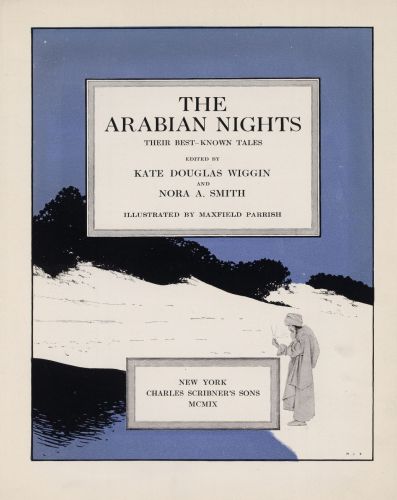
Readers who would like to combine the pleasure of reading a traditional, beautifully illustrated book with the experience of using a cool online site might want to check out the Library of Congress's page turner website, which contains a handful of classic stories including The Arabian Nights and The Secret Garden.
Though the site mainly contains books of interest for younger readers, there are some that might appeal to those who are only young at heart. These include Dickens' A Christmas Carol and Poe's The Raven.
The cool technical part of all this is that the format is booklike--readers can turn pages back and forth. One can also adjust the size of the page.
Thursday, October 22, 2009
Awful Library Books

Sometimes, at the Reference desk, a person will ask for a good book about such and such a topic. If I am feeling especially witty and the person asking the question seems to have a sense of humor, I sometimes say "We only have good books." Then I proceed to really answer the question. I may have to modify my responce as I have come across a site called Awful Library Books. Among the esoteric volumes mentioned are How to Preserve Animal and other Specimens in Clear Plastic and Knitting with Dog Hair. The real point of the site, however, is that public libraries need to weed their collections regularly, so that they don't have ten year old books about how to use a computer, etc.
Monday, October 19, 2009
Non-Fiction Books to Read Before You Die
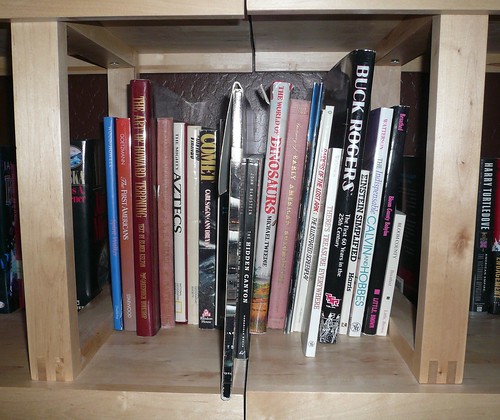
To give the blog an energy boost, we're asking people to name non-fiction books they would recommend. As this will be a kinder, gentler poll, we'll probably expand the list to 25 books. We'd love to know which titles you'd come up with. Please leave your list in the comments.
To get things started, my 10 selections are listed below:
Gifts of the Jews—Thomas Cahill
To get things started, my 10 selections are listed below:
Gifts of the Jews—Thomas Cahill
A Short History of Nearly Everything—Bill Bryson
The Progressive Historians, by Richard Hofstadter
The Progressive Historians, by Richard Hofstadter
Blink—Malcolm Gladwell
The Tipping Point—Malcolm Gladwell
How to Ruin Your Life—Ben Stein
1776— David McCullough
On Writing—Stephen King
You Just Don’t Understand—Deborah Tannen
The Practice of Writing—David Lodge
The Tipping Point—Malcolm Gladwell
How to Ruin Your Life—Ben Stein
1776— David McCullough
On Writing—Stephen King
You Just Don’t Understand—Deborah Tannen
The Practice of Writing—David Lodge
Friday, October 16, 2009
Ah, the literary life...

So, you want to be an author. Before you quit your day job, check out this New Yorker article to see what you’re in for. This satiric piece take the form of a memo from an overwhelmed publisher’s representative, who doesn’t quite seem to know what book you wrote, detailing what you will be expected to do to market your book.
...
The note includes a strong suggestion that you start a blog and pump out 600 words a day, making sure to include numerous pictures of yourself; then you should friend everyone you ever met on you Facebook page; also, you will be participating in the publisher’s RAP (Readings by Author by Proxy) program, in which, to save money, you will do readings at bookstores close to where you live, not only for your own book but others your publisher designates. The memo is loaded with indecipherable jargon-- e.g. “We like Reddit bites (they’re better than Delicious), because they max out the wiki snarls of RSS feeds, which means less jamming at the Google scaffold.”
...
The piece presents a witty and insightful glimpse of the shaky state of the book publishing business today.
...
The note includes a strong suggestion that you start a blog and pump out 600 words a day, making sure to include numerous pictures of yourself; then you should friend everyone you ever met on you Facebook page; also, you will be participating in the publisher’s RAP (Readings by Author by Proxy) program, in which, to save money, you will do readings at bookstores close to where you live, not only for your own book but others your publisher designates. The memo is loaded with indecipherable jargon-- e.g. “We like Reddit bites (they’re better than Delicious), because they max out the wiki snarls of RSS feeds, which means less jamming at the Google scaffold.”
...
The piece presents a witty and insightful glimpse of the shaky state of the book publishing business today.
Tuesday, October 13, 2009
And the Nobel Prize Goes to.....

The Nobel prize for literature this year goes to Herta Muller. I'll have to admit up front that I had never heard of her, but then again, some of the journalists reporting about her selection seemed unfamiliar with her writing.
..
The committee that chooses the Nobel laureates in literature does not always opt for writers widely familiar in America; for instance, the list of the literature prize winners in the last ten years, include such names as Jean-Marie Gustave Le Clézio , Elfriede Jelinek, and Imre Kertész. It is perhaps more interesting that since 1901, when the Nobel prize for literature was first awarded, the committee has passed over such noted writers such as Mark Twain, Leo Tolstoy, Robert Frost, Jorge Luis Borges, Graham Greene, Vladimir Nabokov, and James Joyce.
..
Herta Muller was born in 1953 in a German speaking section of Romania, and a number of her books deal with life under Communist rule of Nicolae Ceausescu in that country. After years of persecution and censorship in Romania, the author moved to Germany in 1987.
..
Only 5 of Ms. Muller's 20 books have been translated into English so far, but with her new celebribrity, this seems likely to change. You can check the Nassau Library System's holdings for Herta Muller by clicking on this link.
..
We'd be interested to know who you think deserves a Nobel prize for literature.
Wednesday, October 7, 2009
NYRB Blog

Just a quick note to let people know that the New York Review of Books now has a blog. What took them so long?
Sunday, September 6, 2009
Book Blogs

For those of you who have read every post in the 10 Books Blog, but still crave more blogs about books, I've gathered some sites I hope you like. All have published posts in the last month. If you have a book blog you'd like to recommend, I'd love to hear about it.
Bookey Wookey
Bloggin’ about Books
Book Lust
A Common Reader
Ex Libris
Farm Lane Book Blog
A Girl Walks into a Bookstore
HPL Book Hunt
HPL Great Books Reading and Discussion Group
Incurable Logophilia
Inside Books
A Life in Books
Mysteries in Paradise
Paper Cuts
Reading Matters
Tuesday, August 25, 2009
Presidential Reading

With summer winding down, President Barack Obama is on vacation on Martha's Vinyard. At this blog, of course, we are interested in what he's reading. Slate, the online magazine, has answered this question in an article called "Barack's Book Bag."
.
We'd love to hear which books you're spending time with this summer. Personally, I'm reading Schulz and Peanuts: A Biography and listening to Silks, by Dick Francis.
Monday, August 24, 2009
Classic Children's Books

NPR has been doing a lot of good stories about books this summer. Their latest profiles classic children's books such as Norton Juster's The Phantom Tollbooth, Jean Webster's Daddy Long-Legs and The House with a Clock in Its Walls by John Bellairs, illustrated by one of my favorite artists, Edward Gorey.
Take a look at the link. Then let us know what your favorite classic children's books are. I'm going with Uncle Wiggily.
Wednesday, July 1, 2009
The Whole Five Feet

Our 10 Books… list looks easy when compared to reading project undertaken by Christopher R. Beha, who set out to read the 51 books in the Harvard “Five-Foot Shelf” of classics in a year.
Charles W. Eliot, president of Harvard University in the early part of the 20th Century, put together the collection as “a good substitute for a liberal education” for the growing middle class who could not go to college at that time. The set, published by P. F. Collier and Son between 1909 and 1917, contains many of authors one might expect-- from Plato to Thoreau, and from St. Augustine to Darwin.
Beha, 27 at the time, worked his way consecutively through each volume. The beginning of this reading project coincided with his aunt’s finding out she had skin cancer. Beha spent time reading at her bedside as the cancer spread. During his year of reading Beha came down with a case of Lyme disease. So, the consolation of philosophy played a part in his real life.
Beha decided to write a chronicle of his reading experience and produced The Whole Five Feet: What the Great Books Taught Me about Life, Death, and Pretty Much Everything Else. Check the work's website after picking up the book from the library.
There was also a good piece about The Whole Five Feet in the New York Times Sunday Book Review
Charles W. Eliot, president of Harvard University in the early part of the 20th Century, put together the collection as “a good substitute for a liberal education” for the growing middle class who could not go to college at that time. The set, published by P. F. Collier and Son between 1909 and 1917, contains many of authors one might expect-- from Plato to Thoreau, and from St. Augustine to Darwin.
Beha, 27 at the time, worked his way consecutively through each volume. The beginning of this reading project coincided with his aunt’s finding out she had skin cancer. Beha spent time reading at her bedside as the cancer spread. During his year of reading Beha came down with a case of Lyme disease. So, the consolation of philosophy played a part in his real life.
Beha decided to write a chronicle of his reading experience and produced The Whole Five Feet: What the Great Books Taught Me about Life, Death, and Pretty Much Everything Else. Check the work's website after picking up the book from the library.
There was also a good piece about The Whole Five Feet in the New York Times Sunday Book Review
Saturday, June 27, 2009
What to Read and What to Skip

Mostly, we’ve been talking here about recommended reading, especially our 10 Books to Read before You Die. But today I came across an entry from the Washington Post’s blog Short Stack that talks about what to skip in literature. The posting mentions a new book called Beowulf on the Beach: What to Love and What to Skip in Literature's 50 Greatest Hits. I have not seen this book, but it sounds intriguing. Its author, Jack Murninghan, has chosen fifty works of literature and goes through each suggesting parts busy readers can skip and parts people should not pass up. The Wahington Post blogger notes books where he went along with Murninghan's recommendations and one (Great Expectations), with which he disagreed.
Personally, I read every word. I don't feel I've read a book if I haven't read all of it. However, I know many people who blithely skim books, skipping parts they consider dull. As the Romans used to say, "De gustibus non est disputandum." If your Lain is rusty, that means there's no accounting for taste.
Friday, June 19, 2009
Beach Books Poll

NPR is asking its listeners to vote for the Best Beach Book of All Time. They define this category as follows: "When you read one, your surroundings recede, time bends and you're transported, mesmerized, enthralled. These are page turners to be sure, but that doesn't mean they're brainless." OK, you have to remember that these are NPR listeners they are talking to.
Go post your vote. Then leave a comment here letting us know about the book you suggested.
Go post your vote. Then leave a comment here letting us know about the book you suggested.
Tuesday, June 16, 2009
Best Books You Never Read

It seems that NPR is on the same wavelength on which we are operating, given that this is the second post referring to them today. In an NPR blog called Monkey See, correspondent Lynn Neary writes about 'The Shelf Of Constant Reproach': Best Books You Never Read." These are those classic books that one owns and has been meaning to read--without much success. Ms. Neary admits to Moby Dick, anything by William Faulkner, and Lolita. I know exactly what she means, as I have whole bookcases that fall into this category. Maybe someday.........
Reading during the Great Depression
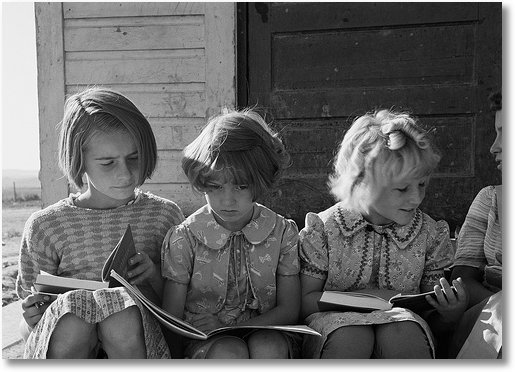
In the midst of the current international economic crisis, there has been much harkening back to see what happened during the Great Depression. In this vein, National Public Radio recently broadcast a segment called "What Were People Reading during the Depression?" The people at NPR went through some issues of Publishers Weekly from the period to see what books were popular.
Though we often ponder how things have changed in the last seventy years, much seems to be the same in the area of popular reading-- chick lit, commentaries by noted politicians, vampire novels, and books about dogs, including a fictional biography of a dog named Flush, by Virginia Woolf of all people.
Oh, yes, and like today, public libraries back then recorded marked increases in their circulation statistics. So join the crowd. Come on into the library and borrow a book.
Monday, June 8, 2009
11 Books You Can't Read

In this blog, we've been discussing 10 Books You Must Read before You Die, so I thought I'd take another tack and point out the article "Short Takes on Books that Don't Exist--Eleven Essential, Imaginary Beach Reads for Summer," published in a journal called Believer.
I came across this piece at one of my favorite sites Arts & Letters Daily. Of course, "Short Takes..." is silly, but we can't be serious (or read serious books) all the time....
Thursday, June 4, 2009
J. D. Salinger Tries to Block the Publication of a Book
 Many people know of J. D. Salinger's passion for privacy. The author, who lives in Cornish, New Hampshire and is now 90 years old, has not had a new story published or given an interview in decades. Salinger is protective of his short stories and his one novel, Catcher in the Rye, which made our list of 10 Books to Read before You Die. Few of his stories have made it to the big screen, and you will not find recorded book editions of Salinger's works.
In the 1980s Salinger fought the publication of a book In Search of J. D. Salinger by Ian Hamilton, which quoted extensively letters Salinger had written over the years. Salinger won that suit, and the book was later published without the quotes from his letters. Now, Salinger is fighting the publication of a novel by John David California called 60 Years Later: Coming Through the Rye. In this book an elderly Holden Caufield-like character named Mr. C. escapes from a nursing home and roams the streets of New York in a story reminiscent of Catcher.
To read further about this dispute check this article from the New York Times and another piece from Publisher's Weekly.
Monday, May 18, 2009
Reading, Not Readings

As the main purpose of this blog is to encourage reading, we wanted to note a recent Chronicle of Higher Education article by Mark Edmundson entitled "Against Readings." That's readings with an "s." "By a reading," Edmundson writes,"I mean the application of an analytical vocabulary — Marx's, Freud's, Foucault's, Derrida's, or whoever's — to describe and (usually) to judge a work of literary art." In other words, let's get back to reading books, without getting wrapped up in literary theory.
I remember reading another article about a young woman's disappointing experience as a graduate student in literature at Yale. At one point she asked one of her professors who her favorite authors were. The professor replied, "I don't read for pleasure anymore." Yikes!
Wednesday, April 15, 2009
Why 10 Books?

We were inspired to ask the Library staff for their choices for 10 Books to Read Before You Die by an article on AOL. When we read AOL's list, we thought "Hmm, wonder what our staff would come up with?" So, we asked, and we received a very enthusiastic response. So then we said 'Hmm, wonder what our patrons would come up with?". This is how we thought we could find out. Just post your picks as a comment-what could be easier?
Subscribe to:
Posts (Atom)